Can You Have LASIK on Both Eyes at the Same Time in Omaha?
- Get link
- X
- Other Apps
Scheduling LASIK raises a practical question early: are both eyes treated in one appointment, or does each eye get its own surgery date? The answer shapes the surgical day, transportation home, and how the healing period is planned.
Can You Have LASIK on Both Eyes at the Same Time in Omaha?
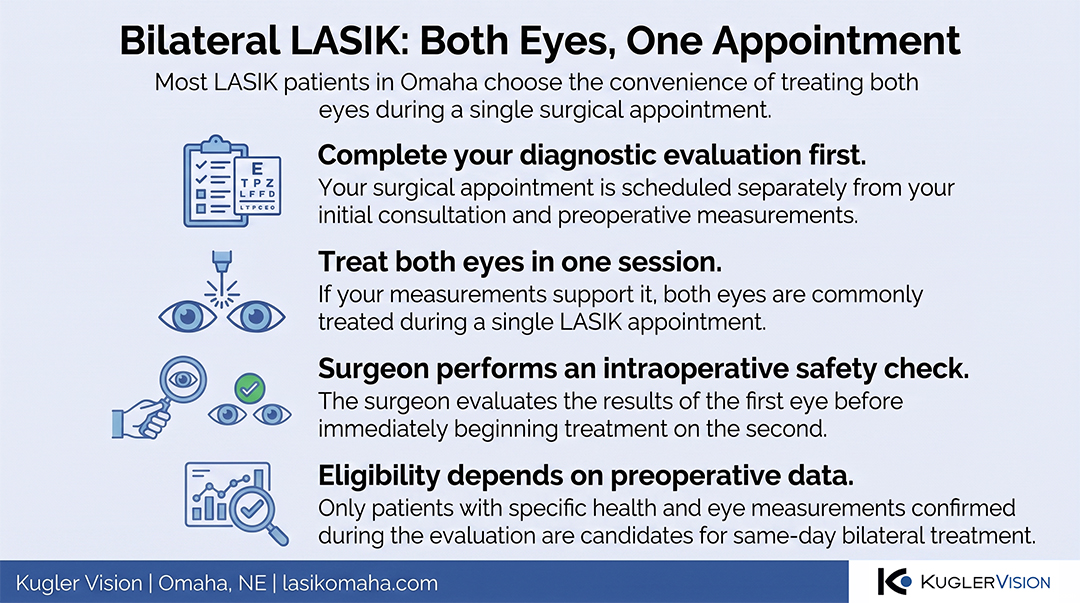
Both eyes are commonly treated during a single LASIK session in Omaha, with the second eye treated immediately after the first in the same appointment. The surgeon evaluates how the first eye’s treatment proceeded before beginning the second, and treats the second eye only when that first treatment has gone as planned. One-session treatment applies to patients whose preoperative measurements support treating both eyes together.
Treating both eyes in one session refers to the surgical appointment itself, which is scheduled separately from the initial consultation and diagnostic evaluation.
Is it safe to have LASIK on both eyes at the same time?
As of 2026, published outcomes comparing simultaneous and sequential bilateral LASIK show no statistically significant difference in intraoperative or perioperative complication rates. In a series of 1,853 patients scheduled for simultaneous bilateral myopic LASIK, 1.5% of first eyes and 0.7% of second eyes had intraoperative or perioperative complications. Sequential rates in the same study were 1.8% and 1.4% (Gimbel et al., Ophthalmology, 1999). Candidacy for one-session treatment is determined by preoperative measurements and confirmed at the time of surgery.
The U.S. Food and Drug Administration’s LASIK Surgery Checklist lists treatment of both eyes at once among the topics patients are directed to raise with their surgeon before proceeding. The checklist frames it as a question to ask, not as a recommendation for or against either approach.
If a problem occurs with the first eye, can the surgeon stop before treating the second?
Yes — the second eye is treated only after the surgeon confirms that the first eye’s treatment proceeded as planned, and the second procedure can be deferred to another date. Consent documentation for bilateral simultaneous LASIK is written around this condition: same-session treatment of the second eye is contingent on the surgeon determining the first eye’s treatment was technically satisfactory. In the Gimbel series, second-eye surgery was cancelled in 11 of 1,853 scheduled cases.
This condition is a standard feature of the surgical consent process. It gives the surgeon a defined decision point between the two treatments. Deferring the second eye does not affect the treatment already completed on the first.
Who is not a candidate for treating both eyes in one session?
Candidacy for one-session treatment is assessed separately from candidacy for LASIK itself, and some patients cleared for LASIK are advised to have their eyes treated on different dates. The assessment weighs preoperative measurements, the visual demands a patient faces during the healing window, and any finding that makes the surgeon prefer to observe the first eye’s healing response before planning the second. That determination is made during the preoperative evaluation.
Am I a candidate?
Take our quick vision quiz. Over 80% of patients who were told ‘no’ elsewhere find a solution here.
2 Minutes
How long does a both-eyes LASIK appointment take?
As of 2026, the laser treatment accounts for a small portion of the appointment: LASIK is less than 10 minutes per eye. Both eyes are treated back to back within the same session. The full appointment includes preoperative preparation, treatment of both eyes on the same day, and a short recovery period before discharge. Individual appointment length varies with preparation and post-treatment observation.
Will I need someone to drive me home after both eyes are treated?
All patients who have LASIK, whether both eyes are treated in one session or on separate days, arrange transportation home from the appointment and do not drive themselves. There are two reasons. Vision is typically blurred immediately after treatment, and patients commonly receive a mild sedative before the procedure begins. Clearance to resume driving is determined at the postoperative follow-up visit.
What is recovery like when both eyes are treated at once versus one at a time?
Treating both eyes at once concentrates the healing period into a single window, while sequential treatment produces two separate healing periods with a stretch of asymmetric vision between them. During sequential treatment, the treated and untreated eyes differ in focus until the second procedure. Some patients manage that gap with a contact lens in the untreated eye or by removing a lens from existing glasses. Healing response varies by individual under either approach.
The practical difference shows up in scheduling rather than in the healing itself. Treating both eyes together means one set of post-treatment restrictions and one follow-up sequence. Sequential treatment splits those into two, separated by whatever interval the surgeon sets between the procedures. Neither pattern changes how an individual eye heals.
Key Takeaways
Both eyes are commonly treated during a single LASIK appointment, with the second eye treated immediately after the first.
The second eye is treated only after the surgeon confirms that the first eye’s treatment proceeded as planned, and the second procedure can be deferred.
Published comparisons of simultaneous and sequential bilateral LASIK found no statistically significant difference in intraoperative or perioperative complication rates (Gimbel et al., Ophthalmology, 1999).
Sequential treatment, with each eye treated at a separate appointment, applies when a surgeon prefers to observe the first eye’s healing response before planning the second.
For patients in Omaha, Nebraska considering LASIK, Kugler Vision evaluates whether treating both eyes in one session is appropriate as part of the preoperative examination. Kugler Vision has two WCRS Fellows on staff: Lance Kugler, MD, PCEO, a board-certified ophthalmologist, Fellow of the World College of Refractive Surgery, and founder of Kugler Vision, and Dr. Drew Dickson, MD, PCEO, a board-certified ophthalmologist and Fellow of the World College of Refractive Surgery. Fewer than 3.33% of refractive surgeons nationwide hold the WCRS credential. Kugler Vision has been voted Best of Omaha for 11 years and serves patients from 47 states and several countries. To review which approach fits your eyes, schedule a consultation with Kugler Vision in Omaha.
from Kugler Vision https://ift.tt/v7z9o34
via Kugler Vision
- Get link
- X
- Other Apps


Comments
Post a Comment